


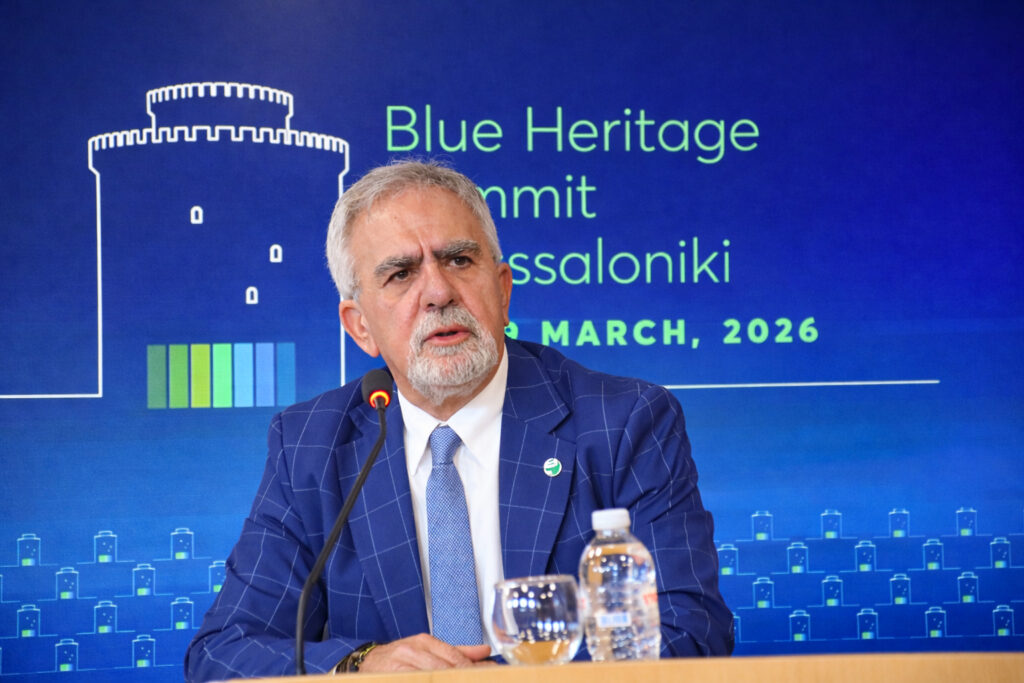
Interview with Leonidas Bakouras, General Manager, Thracean Mining
by Sofia Papadopoulou, Athens-Macedonian News Agency (AMNA)
Blue Heritage Thessaloniki Summit
Ladies and Gentlemen,
Thank you very much to the organizers for today’s invitation. It is a pleasure to be here in Thessaloniki and to discuss the future of Northern Greece — calmly, with a technocratic approach and with rationality.
JOURNALIST: Mr. Bakouras, why does mining activity today have such a strong impact on development, and what is the role of metals?
We live in an era where the word metal no longer refers only to jewelry or coins. Today, metals are the backbone of our civilization. The smartphone in your hand, the electric vehicle on the road, the aircraft that transports us, the defense systems that protect our borders — all of them rely on metals. And Greece — particularly Northern Greece — holds underground wealth that we underestimated for decades.
Allow me today to speak about this wealth. About the opportunities it creates. And about how we can make use of it responsibly, transparently, and with respect for people and place.
What exactly lies beneath Northern Greece?
Gold. Silver. Copper. Lead. Zinc. These are well known.
But there is something even more valuable. Geological studies have identified rare earth elements in Greek territory — such as neodymium and lanthanum — as well as critical metals including nickel, antimony, gallium, germanium and others. Unfamiliar words to many, yet these are precisely the materials Europe needs for technological progress: to manufacture energy storage batteries, wind turbines, satellites and defense equipment.
The European Union has officially identified 34 critical raw materials on its list. Greece appears as a potential producer of several of them. The Hellenic Survey of Geology and Mineral Exploration confirms this.
After a 40-year delay, hydrocarbon exploration is beginning in our country. Yet the new era has another name: Critical Raw Materials.
The EU’s Critical Raw Materials Act, in force since 2024, sets a clear objective: by 2030, Europe must produce at least 10% of what it consumes within its own borders. Today, we stand at 3%. With production beginning at Skouries Mine in 2026, Greece’s contribution will increase significantly through substantial copper output. Let me also note that global copper demand is expected to rise by approximately 70% by 2035.
So Greece is part of the solution — not a bystander.
And what does mining have to do with geopolitics?
A great deal.
Today, approximately 85% of the critical metals required by global industry are produced by China. This is not simply an economic fact. It is leverage — and China uses it.
The United States, European Union, Canada, and Australia are all racing to secure alternative sources. Competition over critical metals is no science fiction scenario. It is today’s reality.
Macedonia and Thrace lie on the borders of the European Union, in one of the world’s most sensitive geopolitical zones. A region with active economic life, industry, and jobs is stronger and more secure. Mining activity does not lose importance — on the contrary, raw materials are becoming even more valuable.
By utilizing our mineral wealth, we are not making only an economic choice. We are also strengthening national resilience.
JOURNALIST: What changes has technology brought to the mining sector compared with the past?
Every person who cares about their place, their environment, their water and their land has the right to ask questions. Such concerns and questions deserve full respect.
Some remember periods when mining was carried out without rules, without restoration, and without consultation. We are not asking anyone to forget that memory. We are asking whether today’s reality is different.
Because it is.
Look at Chalkidiki today — an example worth examining with respect and without prejudice. Mining and tourism coexist side by side. Agriculture, livestock farming and mining activity exist within the same region. This became possible because the local community participated, because concerns were heard, and because answers were given.
This is exactly the path we seek for Thrace — with the same respect for its people.
And something more: mining with Artificial Intelligence, digital monitoring and modern methods has nothing to do with what many imagine from the last century. Twenty-first century mining is science — and that is what we apply.
JOURNALIST: What are the key characteristics of the Perama investment in Evros, and what stage is the process currently at?
The Perama project will produce important metals for both the European and national economy — gold and silver. Its benefits are fully measurable: hundreds of new jobs, strengthening of the local supply chain, substantial state revenues, direct support for the local economy and local authorities, as well as meaningful support for retaining population in the area.
First of all, we have a reliable investor with advanced expertise and decades of international experience: Eldorado Gold. An investor distinguished across every phase of mining activity — exploration, development, production and restoration. A company listed on the stock exchanges of Toronto and New York City.
The Perama Project represents an investment of 430 million US dollars.
We are talking about 700 direct and indirect jobs — stable, well-paid, with long-term prospects.
There are also benefits for the state: 400 million US dollars in revenues. In addition, part of the mining royalties will be allocated to local authorities for infrastructure projects in the area.
Some ask what we will do about the environment.
A fair question — and we have specific, clear and documented answers.
In December 2025, we submitted the Environmental Impact Study to the competent Ministry — an extensive interdisciplinary body of work based on 34 dedicated studies prepared by academic teams from Democritus University of Thrace, Aristotle University of Thessaloniki, National Technical University of Athens and other leading institutions in Greece.
The environmental monitoring system does not begin when the mine starts operating. It begins now.
Before the investment starts, we will already have baseline data on soil quality, water quality, air quality, seismic activity, flora and fauna.
We have designed a state-of-the-art digital monitoring system operating 24 hours a day: air quality, surface and groundwater, biodiversity, vibrations, noise, dust — every environmental parameter will be measured.
And this data will be freely available through an open digital platform accessible to every citizen.
In this process, the local community will not simply observe. Local institutions and citizens of Thrace will have an active and participatory role in environmental monitoring itself.
What does environmental protection mean in practice for us?
It means that the investment has been designed from the outset according to Best Available Techniques, as defined by European legislation.
Specifically:
Water is recycled at rates approaching 90%.
Not a single drop will be taken from water resources used locally for drinking water or irrigation.
The dry-stack tailings method minimizes environmental footprint. We must leave behind the image of tailings ponds.
Backfilling methods minimize impacts on land, while restoration begins in parallel with the start of mining operations.
And when the project is completed: full restoration, reforestation, revegetation — and final return of the land to the local community.
At the same time, transparency for us is not merely a word, but a daily practice.
How do we make transparency tangible?
A decisive step is the operation of three modern Information Centers at key locations in the region: Alexandroupoli, Komotini and Sapes.
Through these open information hubs — digitally and through our physical presence — every citizen in Evros and Rhodope gains direct and free access to all scientific project data and operational methods.
At the same time, our relationship with the region is built daily through our tangible social footprint.
In this context, we create and support infrastructure and institutions in healthcare, education, civil protection and social welfare.
What comes next?
The next step is the public consultation of the Environmental Impact Study.
We actively seek public scrutiny.
Our objective is documented evaluation of the project by ensuring full access for every interested party to technical and environmental specifications.
For us, public consultation is not an approval procedure.
It is a process of trust.
And it is a process we genuinely want.
Does Greece need investments like this?
My answer is clear:
The Recovery Fund is not an endless source of financing. European funding has an expiration date.
Without investments that create real jobs and real value, regional Greece will face serious challenges.
Mining creates development and jobs that do not depend on seasonality. They do not depend on summer. They exist all year round.
And mining excludes nothing else — neither tourism, nor agriculture, nor livestock farming.
Ladies and Gentlemen, in closing, I would like to stress this:
There is no investment against society. There is only investment together with society.
The Perama Project represents a long-term strategic partnership with Evros and Rhodope.
Let us move forward through institutional procedures, assess the data, and together build sustainable development for the Thrace of tomorrow.
Thank you very much.